Speed, Scale, Defensibility (now with AI)
Move fast, but only in service of learning. Scale when experiments become systems. Build your moat with data, trust, and integration.
TL;DR: Move fast, but only in service of learning. Scale when experiments become systems. Build your moat with data, trust, and integration. Then measure everything.
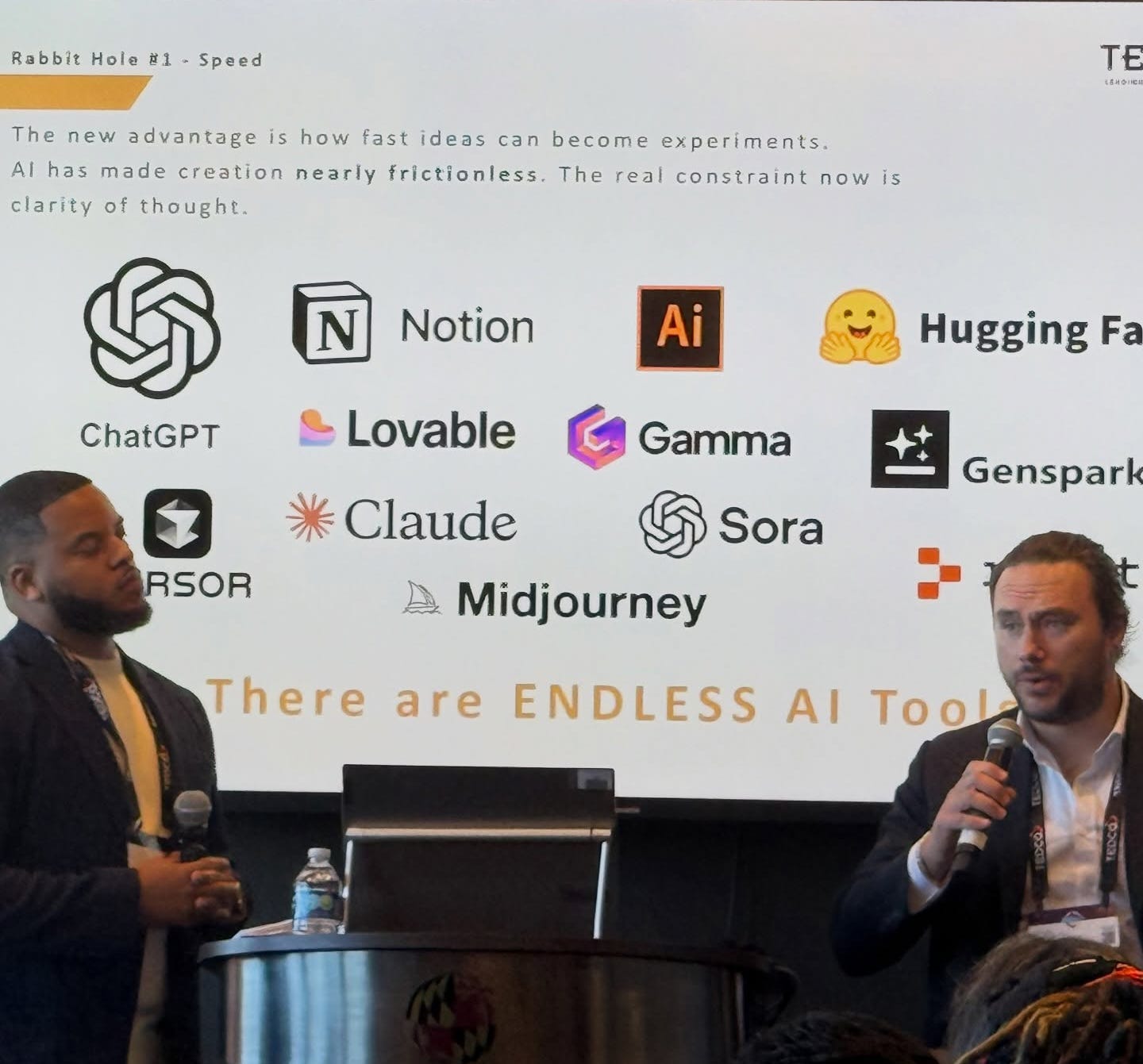
Yesterday’s panel was one of my favorites to be a part of. Let’s break down what we discussed.
The quick truth
Most teams are still stuck between “we bought licenses” and “we see ROI.” The gap is not the tech. The gap is alignment, clean data, and adoption you can measure.
At the TEDCO panel, we framed the journey in three parts:
Speed: Use modern tools to ship prototypes in hours, not months. Speed only matters if it increases learning.
Scale: Promote what works into repeatable systems with clear owners, metrics, and change control.
Defensibility: Your moat is data quality, team expertise, and tight integration into real workflows.
Speed: build to learn, not to check a box
Treat AI dev like rapid product discovery. Small bets, short loops, real users.
Use AI dev tools to unstick bottlenecks and get signal quickly.
Make learning explicit. Each sprint must answer a question, not just add a feature.
Starter loop
Define the decision or outcome you want.
Ship a narrow prototype in 24–72 hours.
Test with real inputs and real reviewers.
Keep what works. Kill the rest without guilt.
Scale: when experiments become systems
Document the “happy path” and the edge cases you learned during discovery.
Assign ownership. Decide what is human and what is machine, on purpose.
Align to business outcomes. If the process does not move a KPI, it is noise.
Promotion checklist
Clear definition of done
Input and output standards
Privacy and compliance sign-off
Monitoring, alerts, and rollback plan
Training and handover complete
Defensibility: data, people, and integration
Data: Clean, consistent, and explainable. Outliers matter. Build pipelines that keep your test sets pure so you can prove improvement.
People: Champions convert skeptics. Trust drives adoption. Adoption drives ROI.
Integration: The moat is how deeply the system fits the work, not the model label. If it snaps into your process and language, it sticks.
The simplest framework I teach
We ask AI to do things with our data.
We ask = prompt engineering and patterns that capture how your team actually works
AI = model selection, fine-tuning, or creation
To do things = agents and human-centered service blueprinting
With our data = the hidden fourth piece that makes everything real
If your data is a mess, your outcomes will be too. Fix the data paths early.
Adoption beats policy
Do not start with “ten licenses for everyone.” Start with two licenses, prove 10x value, then scale.
Create feedback loops. Capture the best prompts, examples, and outcomes from real work.
Survey your team for fear, trust, and usage. Meet people where they are. Champions lead the way.
Metrics that tell you it is working
Accuracy and quality: As good as or better than your human baseline where it matters.
Cycle time: Hours to minutes on targeted tasks.
Adoption and trust: Measured monthly, not guessed.
ROI: Time saved, errors avoided, revenue influenced. Tie pilots to a number.
Use OKRs. Kill key results that stop serving the objective. Update mid-quarter. No waiting for Q4 to admit reality.
What to automate vs what to keep human
Decide this on purpose and make it cultural.
AI routes, drafts, extracts, reconciles, and watches for anomalies.
Humans judge, approve, coach, and own exceptions.
If an executive needs an AI summary for every decision, your upstream process needs work.
A safe, fast path you can start this month
Week 1: Baseline
One hour alignment session with the real stakeholders
Map the process and decisions with a lightweight Service Blueprint
Weeks 2–3: Prove
Pick 1 to 3 high-impact, low-risk use cases Examples: contract summarization with traceability, long meeting capture with action items, document generation from approved templates
Ship narrow pilots with monitoring and human review
Weeks 4–8: Adopt
Train your champions. Stand up a prompt and pattern library.
Measure adoption, quality, and cycle time.
Promote winning pilots to system status with owners and runbooks.
Weeks 9–12: Defend
Harden data pipelines and access controls.
Add model-swapping to avoid lock-in and optimize cost.
Expand agents into adjacent workflows only where ROI is proven.
Final word
Speed without learning is chaos. Scale without metrics is theater. Defensibility without trust is fiction. Get the people, the data, and the decisions right, then let AI do what it does best.
If you want help turning this into a working plan for your team, grab time with me. We start with a simple conversation, create a clear blueprint, and deliver quick wins you can measure.
Thank you to our moderator and co-panelists
Moderator: Justin Ferguson, TEDCO
Tim Kulp, Mind Over Machines, Inc.
Debra Cancro, Independent Consultant
Jesse Alton, Virgent AI
Want more?
Aligning prompts, models, and objectives ensures AI truly delivers—because two out of three is never enough.
We Ask: Prompt engineering must be strategic.
AI: The model must match the task.
To Do Things: The objective has to solve a real user or business problem.
As CEO of Virgent AI, I’ve watched companies transform by respecting these three elements equally. We’re living in a moment when code is half written by us, half by AI, and soon we’ll all have personal agents guiding our workflows. If you haven’t already, please subscribe to this blog to see how we apply this thinking in real-world contexts.
It’s an exciting time. Prompt responsibly, design compassionately, and keep your objective front and center, because that’s how we harness AI for meaningful change. Interested in more content like this? Check out “We Ask AI To Do Things,” and consider subscribing.

Originally published on The Interop (Substack)
Jesse Alton
Founder of Virgent AI and AltonTech. Building the future of AI implementation, one project at a time.
@mrmetaverseRelated Posts
On AI modernization, making a safe purchase, and hoping AI Just Works
I hear the same story every week. A leadership team banned AI in 2023 over data-leak fears.
Good Tool, Bad Tool
The adoption of AI tools continues to surge, and shadow IT—where employees use unauthorized or personal tools to get their work done—has become an...
Subscribe to The Interop
Weekly insights on AI strategy and implementation.
No spam. Unsubscribe anytime.